For Kerubini, Pierre Portelli places five cherubs at the threshold between altar and congregation, each holding a mobile phone and photographing the recently restored altarpiece by Mattia Preti. The gesture is legible at once, and the work's ambition lies in what that legibility conceals. Portelli does not offer a comment on screens in church. He proposes that the contemporary act of photographing a sacred image belongs to a long history of mediation, and that conservation itself participates in it. The proposal gains urgency from the condition in which images now exist, for the photograph taken before the Preti is no longer a picture in the older sense. It is data, and its morphology differs radically from that of the painting it records. The iconographic basis is the Baroque cherub, which in Counter Reformation church decoration holds attributes, supports cartouches, draws back drapery and directs the gaze of the faithful toward the holy. Such figures are never the subject of the image. They are its apparatus. Behind them stands a deeper pictorial principle, Alberti's festaiuolo, the figure within the scene who addresses the viewer and guides attention, and the theatrical architecture of Bernini's Cornaro Chapel, where sculpted spectators observe the ecstasy of Teresa from their boxes.
The Baroque church already staged the spectator as part of the work. Portelli retains this inheritance and changes a single attribute. Where the cherub once bore a garland or an instrument of the Passion, it now bears a device of capture. The change of attribute carries a change of ontology. Preti's canvas is a singular body of pigment, ground and fibre, which ages, darkens and can be cleaned, and which a restorer can meet only in one place. The image produced by the cherub's telephone is of another order. It is a file, copyable without loss, tagged with location and time, compressed, uploaded, indexed and recombined by systems that read it as pattern before any person reads it as picture. It has no fixed site and no single state. It exists in multiplicity, in versions and derivatives, and its life is measured in circulation, not in decay. The dossier's observation that meaning no longer resides in place but in mobility describes with some precision the passage from the object that can be conserved to the image that can only be propagated. The philosophical force of Kerubini rests on its refusal of a familiar critical script. Since Benjamin, mechanical reproduction has been understood as the erosion of aura, and later writers on photography and the digital image have largely extended that suspicion. Portelli's work moves closer to the positions of Hans Belting and Régis Debray, for whom images have never existed apart from their media and are sustained by the systems that carry them. Michel Serres, in Angels: A Modern Mythology, identified the angel as the ancient figure of the message and the network. A cherub with a telephone is, on this reading, not a corruption of the angelic function but its return, and the networks of the present, with their servers, cables and platforms, are the unacknowledged heavens through which such messengers now travel. Agamben's account of profanation, in which an object is restored to common use rather than destroyed, supplies a further frame for the curatorial claim that the sacred is here liberated and not annihilated. The work's most original proposition concerns conservation. Before any visitor raises a phone, the restorer has already looked at the Preti through material analysis, photographic documentation and technological imaging, and the painting's renewed visibility is the product of that prior form of looking. The visitor's snapshot repeats the restorer's act in a vernacular register. Both produce images of the work, one to understand and preserve, the other to remember, possess or confirm an encounter. The two practices differ in their economies as well as their purposes.
The conservator's record is slow, calibrated, archived against loss and answerable to the object. The visitor's record is instantaneous, abundant and answerable to no one, yet in aggregate it forms an immense and unplanned archive of the same painting, taken from every angle, in every light, by thousands of hands. Kerubini thus collapses the distinction between professional and popular mediation and gives the wider project its internal coherence, since conservation appears as an epistemological act that creates the conditions of a new encounter and not as a neutral return to an earlier state. This aligns the work with Gianni Vattimo's pensiero debole, in which presence persists through weak, mediated and distributed means and not through claims to stable permanence. The viewer's position completes the argument. Visitors who photograph the cherubs photographing the painting enter the circuit the work describes, and no vantage point remains outside it. The structure recalls the closed reflexivity of Velázquez's Las Meninas, as read by Foucault, yet it lacks the accusatory edge of much media critique. Today the circuit is closed in a further sense, because the images captured in the church do not terminate with their makers. They return as training material for systems that learn to see, to classify and to generate, and those systems in turn produce images that circulate back into the same economy. The photograph of the altarpiece becomes a trace in a feedback loop, in which perception, storage and synthesis are no longer separable. The work implicates its audience without reproaching it, and it ends, in the words of the dossier, by recording the question of resilience or loss and not by answering it. The question has a future tense that the work invites but does not state. As images become increasingly generated and not merely captured, the status of the documentary photograph as evidence, which the dossier identifies as one of its central functions, grows unstable.
A sacred image may soon circulate in countless synthetic variants, restored, enhanced or invented by algorithms, so that the visitor's snapshot of a real painting becomes a rarer and more fragile kind of witness. In that setting the conservator's insistence on the material object, on what can be measured, sampled and dated, acquires a new significance as a guarantor of origin. The cherub's telephone then appears in a double light. It is an instrument of witness, and it is also the first link in a chain that may eventually obscure what it set out to confirm. There is a further irony for conservation itself. Digital files are among the most vulnerable records of the present, dependent on formats, platforms and energy supplies that may not endure, so that the archive of a restored altarpiece may prove more perishable than the canvas it documents. The Baroque cherub was carved or painted in materials meant to outlast its makers, whereas its descendant holds a memory that requires constant tending to survive. Conservation, in other words, will have to extend its reach from the object to the image, and from the pigment layer to the data layer. The work's place in the history of the mediated gaze should be stated with care. The photographing of artworks by their audiences has been examined extensively, from the museum photographs of Thomas Struth and Andreas Gursky to the crowd before the Mona Lisa as a recurring image, and from Hito Steyerl on circulation to Erik Kessels on photographic excess.
The device of a classical figure holding a phone is also familiar from popular and street culture, and a first encounter may register it as a witty update. The claim to novelty therefore does not rest on the motif or on the subject. It rests on three joinings that are rarely made together: the Baroque iconography of mediation, the imaging regime of conservation science, and the contemporary photographic economy, set within a working church whose altarpiece has just been restored and whose visitors complete the work by behaving as they ordinarily would. The camera moves from the spectator's hand into the artwork's own iconographic machinery, and the restorer is placed beside the tourist as a fellow producer of images. Kerubini is best understood as a rigorous and well situated synthesis, and not as a rupture in the history of contemporary art. Its significance is greatest for the Maltese context, where it offers a model of intervention that is answerable to a specific object, a specific restoration and a specific community of viewers. Its lasting interest will depend on a question the work leaves open: whether the meaning of an image changes when the manner of seeing changes, or whether that meaning survives precisely because it can be mediated differently. As the morphology of images continues to shift from the singular to the replicable, and from the recorded to the generated, that question will only grow more pressing, and the cherubs at the threshold will remain, for a time, its most patient witnesses.
“Installed at the architectural threshold between altar and congregation, the work frames digital mediation as a contemporary continuity of the cherub's historic witnessing role, positioning contemporary spectatorship in an unceasing loop of image circulation.”
Pierre Portelli
Church of St Francis of Assisi, Valletta
Five sculpted cherub figures fitted with active mobile smartphones photographing the altarpiece, synchronized digital display feeds
Dimensions variable (five figures in installation)
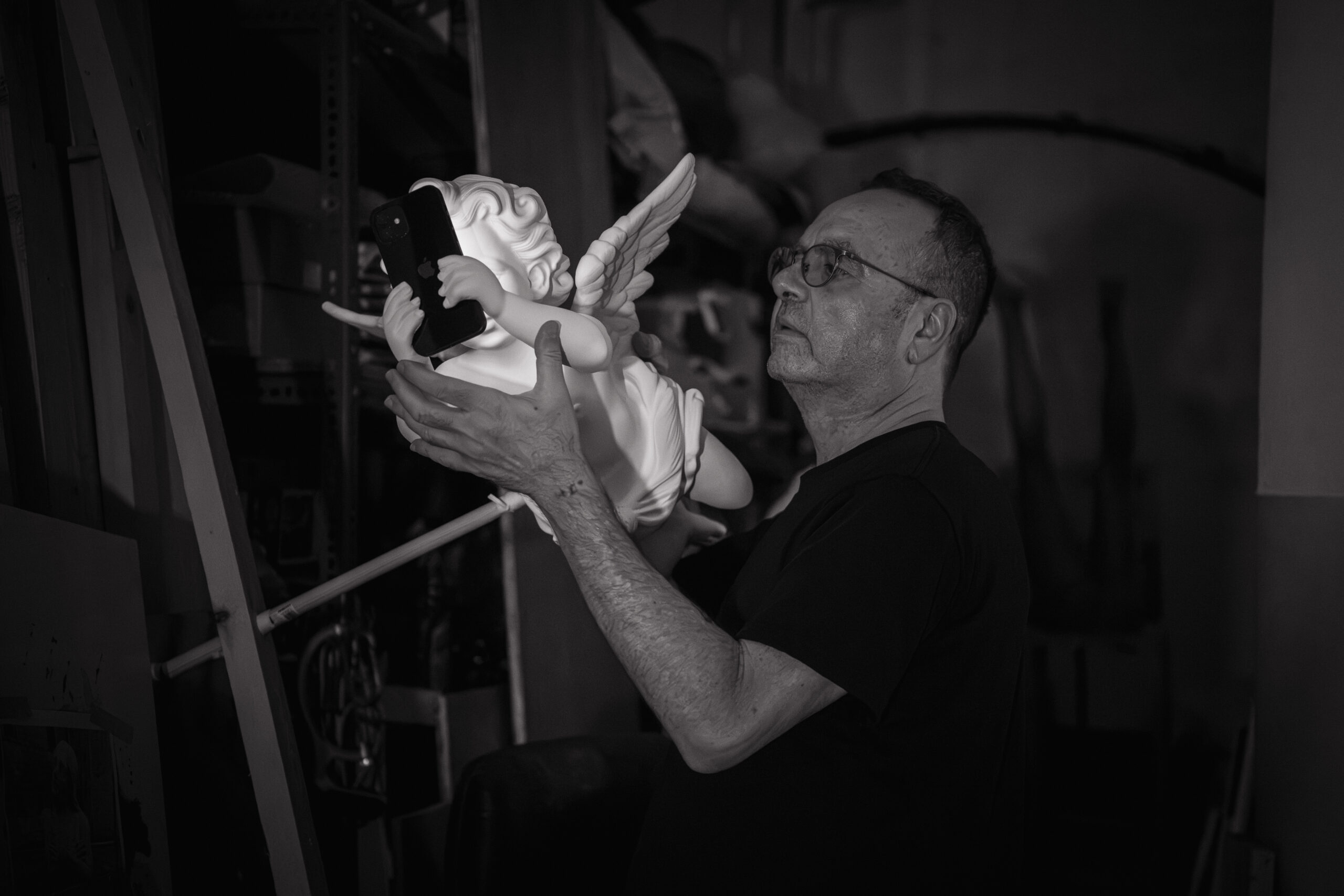


Pierre Portelli's Kerubini installation photographing the Mattia Preti altarpiece
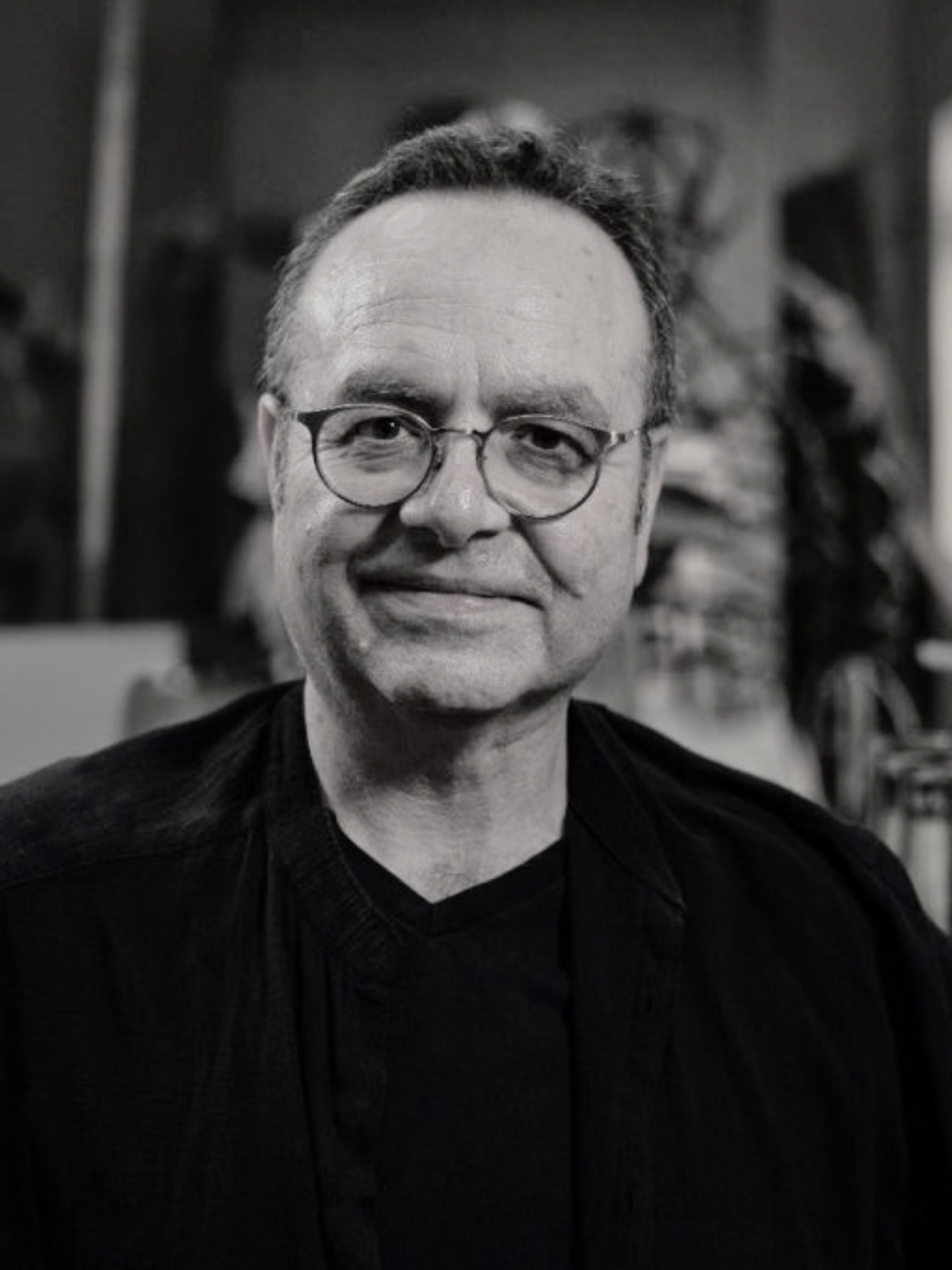
Pierre Portelli
Pierre Portelli (born 1961) works mainly in installation, sculpture, video and mixed-media art. He explores and makes use of various media, including coir, chewing gum, concrete, live vegetation, steel, mirrors, sound, wood, new technologies, and repurposed objects, amongst others. His work investigates processes of change, interaction and the temporary meeting of social worlds through sculpture, site-specific work, language, and sometimes playful tongue-in-cheek undertones. He studied at the Swindon School of Art and Design in the U.K. and is a founding member of stART, a Maltese contemporary art group, and a collaborator of The Little Constellations Network for Contemporary Art. In 2003 he collaborated with Love Difference and Michelangelo Pistoletto at the 50th Venice Biennale. He is a visiting lecturer at the Faculty of Education at the University of Malta. Pierre Portelli has exhibited in national and international institutions such as the Ostrale Biennale, Dresden, Germany; the BOZAR and the European Commission, Brussels, Belgium; MICAS, Malta International Contemporary Art SPACE; the Malta Maritime Museum and the National Museum of Fine Arts in Malta; the National Gallery of Iceland, Reykjavík; Fabbrica del Vapore, Milan, Italy; the Central Connecticut State University, U.S.A.; the Biennale du Design in Saint-Étienne, France; the Palais Kheireddine, Tunis, Tunisia; Palais Liechtenstein in Feldkirch, Austria; the Museum for Contemporary Art, Villa Croce, Genoa, Italy; the Kunstraum Engländerbau, Vaduz, Liechtenstein; the Athens Metro, Athens, Greece; the Monastero di Santa Chiara, Republic of San Marino; the Montagu Bastion, Space for Contemporary Art, Gibraltar; the Magazzini del Sale, Cervia, Italy;The RRF Project - [Remembering] [Repressing] [Forgetting], Germany; the Pierides Museum of Contemporary Art Nicosia, Cyprus; the “Village of Solutions” MEDCOP21 in Marseille, France; the Bautzner Strasse Memorial Stasi Prison, Dresden, Germany; Barely Fair, Julius Caesar Gallery, Chicago, U.S.A. His work is found in the National Collection of Malta, MUŻA National Museum of Fine Arts, Valletta; the National Gallery of Iceland, Reykjavík; the Little Constellations Archives in San Marino; the U.S. Art In Embassies Collection of the State Department; and in numerous private collections both locally and abroad. Pierre Portelli has originated cross-disciplinary research-based projects with music composers and performers, choreographers, actors, and authors, and is a frequent collaborator in theatre productions.