X-Corpus
by clint calleja
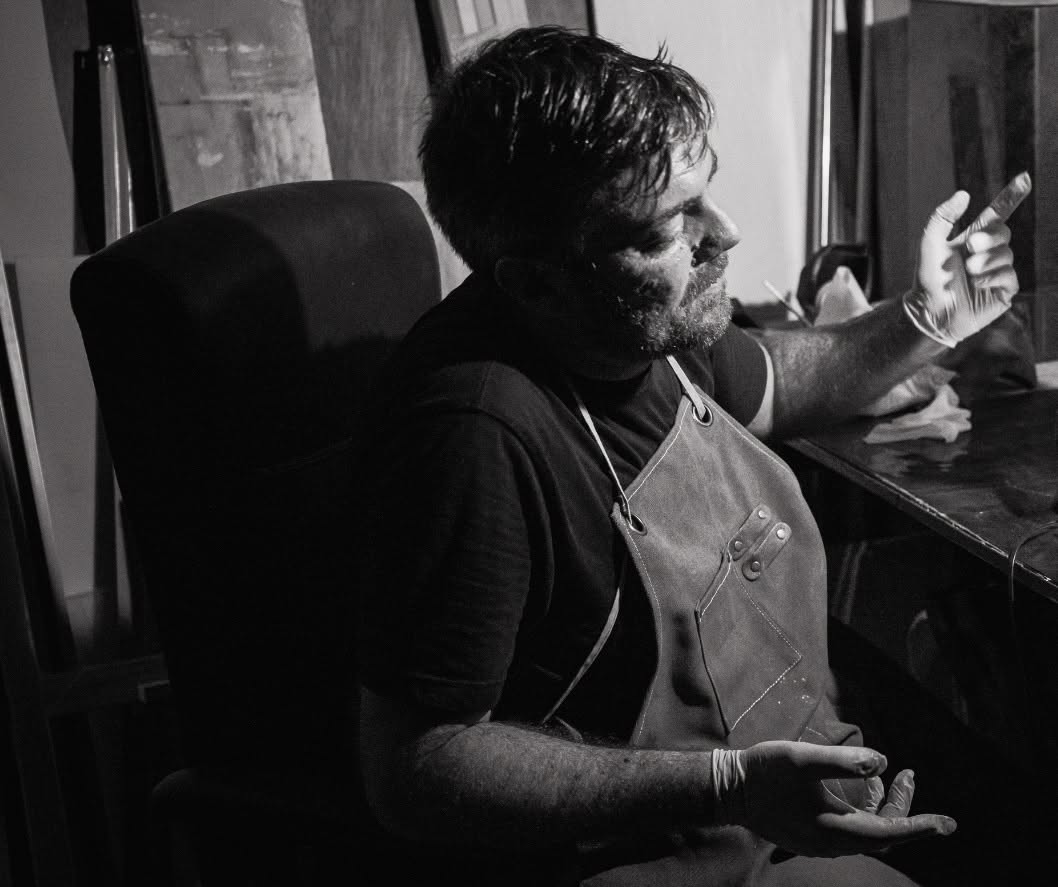
For Allegoria, Clint Calleja revisits the Baroque, polychromed, life-sized crucifix at the Parish Church of the Annunciation of the Virgin in Tarxien for the production of his work titled X-Corpus. During his time at RECOOP, Calleja was directly engaged in the crucifix's conservation and restoration back in 2011, which was in a dire state of preservation with pertinent issues ranging from a darkened polychromy as a result of oxidised filmogenic substances as well as an acute insect infestation. Clint Calleja's hands lingered on the edge of entropy, challenging the inevitable destruction of time and death. Prior to any intervention, the crucifix underwent a thorough process of documentation which included X-RAY imagery.
Calleja's deep understanding of decay and materiality, both of which which feature frequently in his art, are set to be intertwined with the intense X-RAY images of the crucifix. This work takes as its point of departure the material vulnerability of the crucifix at Tarxien, an object whose presence has endured not through noble materials or monumentality, but through fragility, exposure, and care. Calleja's intervention does not aim to reproduce the image, it interrogates the conditions under which such an image can still exist. The crucifix is internally activated using light funnelled through channels that follow the X-RAY imagery. Clint is a true magician of materiality. His works are the result of intense alchemical interventions ranging from concrete, marble composites, ceramics, stone, steel and 3D printed resin. The process of X-CORPUS was systematic, cold, rhythmic, and mechanised. The Baroque crucifix was scanned using a 3D scanner and the X-RAYS taken as part of the diagnostic process where then integrated with 3D software into the fabric of the scan. Using the same software, Calleja sculpted and formed X-CORPUS' 'flesh' to allow for the light to pass in an outwardly manner through elements of degradation and structure. Calleja's crucifix was then fragmented for its production using 3D printing via vat photopolymerisation which hardens liquid photopolymer resin layer by layer using an ultraviolet (UV) light source. The printed pieces are then cured with isopropyl alcohol and UV-light. This 3D process is also used in the weapons manufacturing industry to cast customised solid rocket propellant, micro-fuses and ceramic cores for casting specialised munitions. This duality of the apparatus used in X-CORPUS as part of Allegoria, provides an essential gravitas to the project which chooses to cure and create rather than to destroy or annihilate. As an artist, as a sculptor, Clint Calleja takes matter, in this case a nylon black photopolymer resin, to its absolute limit by injecting into it process, rigour, intuition and discipline in spite of a high degree of unpredictability leading to warpage and shrinkage, thus transforming it into a cutting-edge artistic medium. The technology traditionally used to conserve and diagnose heritage objects is here repurposed as the source of the image itself. In contrast to the endurance of the historic crucifix, this work operates continuously, dependent on internal activation to remain visible. Presence is no longer secured by permanence, but by ongoing mediation. The crucifix does not survive unchanged, it functions, revealing vulnerability as a contemporary condition of meaning.
Rather than illuminating the surface, the work generates visibility from within, allowing presence to emerge through exposure and scrutiny. The structure, holding Calleja's crucifix also mirrors the niche that houses the Baroque crucifix. Through this, the darkness of the enclosure takes on a Christological dimension where it surrounds the body of the Crucified, creating a visual field of suffering, death, and absence, even as the body itself remains visibly present. It holds the Crucifix within the unresolved tension between death and presence that defines the Passion. The structure, emulating an iconostasis, features a reflective surface on its reverse side, so that before entering the Chapel, visitors first encounter their own reflection, not as an act of vanity, but of conscience.
“Repurposing conservation X-ray diagnostic technology as its primary image source, the work funnels light through internally routed channels that trace the crucifix's hidden interior fractures, generating visibility from within rather than illuminating its exterior surface.”
CLINT CALLEJA
Clint Calleja (born 1983) is a Maltese multidisciplinary artist whose practice spans painting, sculpture, printmaking, and installation. He holds Master’s degrees in both Fine Arts and Baroque Studies, combining a contemporary creative outlook with a deep understanding of historical contexts and materials. His work frequently explores themes of memory, identity, and cultural continuity, with a strong focus on material process and transformation. Calleja currently lectures in Fine Art at MCAST, where he nurtures the next generation of artists while developing his own practice. Between 2007 and 2013, he was employed by Recoop, where he contributed to the restoration of several landmark heritage sites in Malta and Gozo. These included the Co-Cathedral of St. John in Valletta, the Mdina Cathedral, the Carmelite Priory in Mdina, and the Mdina fortifications. These formative experiences deeply influenced his artistic language, instilling a fascination with material history and the layering of time. Believing the past serves as a blueprint for the future, Calleja integrates traditional restoration techniques with contemporary media and new technologies. He is especially interested in revealing beauty through materials and objects often considered mundane, obsolete, or aesthetically unremarkable challenging viewers to reconsider notions of value and perception. He has participated in several significant group exhibitions, including the Mdina Biennale (2017), Identity of an Island (Gozo, 2022), Sculptura (2023), and BUT I SEE BEAUTY AND WONDER... (Spazju Kreattiv, 2025). His solo exhibitions include Anamnesis (SpazjuKreattiv, 2023) and GENESI 1011 (il-Kamra ta’ Fuq). His works are held in both private collections and public institutions.